
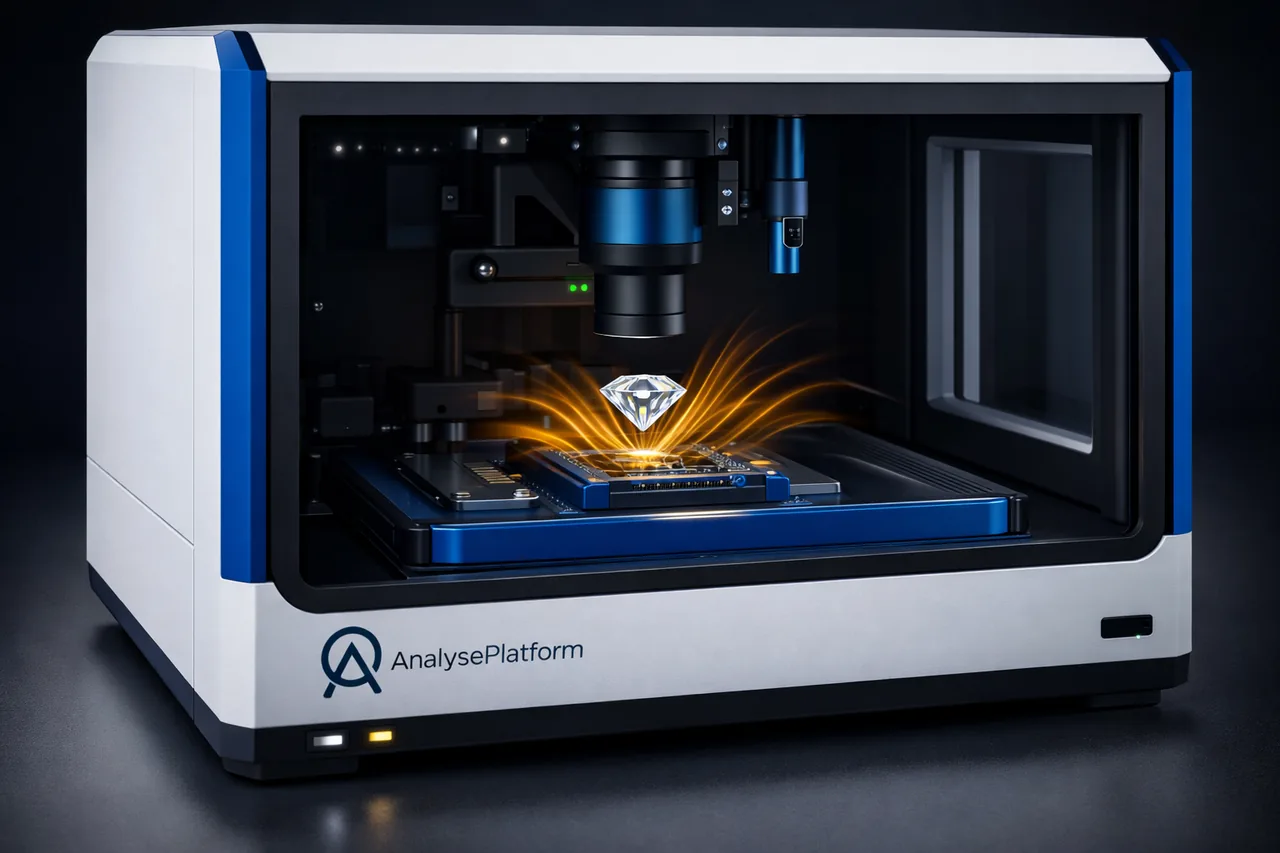
Current device. The existing prototype is already operational.
What changes next is productization, enclosure refinement, and commercial polish — not whether the core system is real.
A compact hardware-and-software system for standardized spin-qubit characterization — built on a real prototype, a real software stack, and real measurement workflows already running today.
Spinoff in formation from Advanced Quantum · Contractor in the DLR Quantum Computing Initiative (SQuaP project).
Numbers and capabilities above are design targets — refined through ongoing user interviews, not committed specs.
The product is being commercialized from an existing internal stack: a real compact prototype, a real laboratory foundation, and real measurement software running today. The commercial enclosure and product UI are still evolving — the underlying system is not.

Compact prototype hardware exists. Measurement software exists. The workflow runs. The current design challenge is turning proven internal capability into a commercial system that pilot customers immediately trust.
If you can't measure qubits consistently,
you can't build quantum technology.
Every lab measures differently — making results hard to reproduce, trust, or scale. That works in early research. It breaks when a field starts to industrialize.
Analysis relies on custom scripts written by individuals. When they leave, the knowledge leaves with them.
Every lab builds its own pipeline from scratch — confocal setup, measurement scripts, analysis code, reporting. Nothing is reusable.
Results vary between people, setups, and time. Comparing measurements across samples, batches, or labs requires manual effort.
Startups manufacturing diamond or SiC substrates must characterize every batch — but there is no commercial system built for exactly this.
The shift is not incremental — it removes an entire category of operational burden.
"Sample in, report out" is the target workflow — built on top of the working prototype and the existing measurement software stack. No more fragile pipelines. No more results that leave when the postdoc leaves.
A dedicated, all-in-one characterization system — including microwave source, RF electronics, and laser. Not a replacement for your confocal, but the missing piece between raw measurements and comparable results.
Integrated confocal optics locate and identify color centers — no manual alignment needed.
defect localization in <10 min on 4×4 mm samplesPre-defined ODMR, Rabi, Ramsey sequences. No more person-dependent measurement routines.
ODMR + Rabi + Ramsey in <30 min per site, unattendedAutomated fitting, parameter extraction, and quality checks — built in, not bolted on.
automated fits within ±5% of expert manual analysisStandardized, export-ready reports. Finally, characterization data that means the same thing in every lab.
one report schema across samples, operators, and yearsStep-level targets are design references — refined through ongoing user interviews, not committed specs.
The bright interface below is the real internal measurement software, running today. The dark interface is where the commercial product UI is heading — clearer hierarchy, better operator experience, stronger trust signal.


Most existing tools solve one part of the characterization problem. Our system is designed to close the gap between raw measurements and comparable results — without replacing the parts that already work.
Today, qubit performance depends on individual setups, scripts, and people. That makes results hard to compare — and impossible to industrialize.
We believe characterization is the missing infrastructure layer between experimental physics and scalable quantum systems — the same role a spectrometer plays in chemistry, or an oscilloscope in electronics.
Whoever defines trusted measurement workflows early gets the distribution, the data advantage, and the language of the category.
The first infrastructure layer for scalable quantum hardware.
Whether you're characterizing samples for research or for production quality control — the pain is the same. The first fit is with teams that already feel it.
The program is for a small number of teams that already feel the pain. Partners help shape first-generation priorities — specs, workflows, report formats — and get a direct line into the decisions that matter while we're still defining them.
Map today's measurement, fitting, and reporting pain points with your team. About 30 minutes.
Prioritize first-generation capabilities around the operational value you actually need.
Define where integrated hardware and software meaningfully reduce your internal burden.
Early deployment path into the first commercial hardware runs, with preferred support.
This company is being built by operators who know the pain of manual fits, fragile scripts, unclear standards, and the cost of losing workflow knowledge with people.
Advanced Quantum Devices is a spinoff in formation from Advanced Quantum, a contractor in the DLR Quantum Computing Initiative under the SQuaP project (Spin-Qubit Analysis Platform for Color-Center-Based Systems, 2023–2026). Our parent company develops a mobile two-qubit system based on silicon carbide — giving us direct, hands-on experience with the exact characterization workflows this platform is being built around.
The founder worked personally in the Wrachtrup group at the University of Stuttgart, one of the foundational labs for NV-centre and spin-defect research. The product is rooted in that workflow reality, not reverse-engineered from outside the field.
We've spent years running exactly the characterization workflows we're now building a product around. We know the late nights fitting ODMR spectra with fragile scripts. We know what it's like when a colleague leaves and their analysis pipeline leaves with them. We know the pain — because it's our pain too.
Our vision is simple: every lab that works with spin defects should have a standardized characterization tool on the bench — the same way every chemistry lab has a spectrometer. Not a pile of custom scripts, but a proper instrument.
We're designing the first version right now. If you participate early, your needs directly influence the specs. This is your chance to get the tool you actually want — not what we think you need.
This is an early-stage survey to gauge general interest — no commitment, no sign-up. We're learning how labs and companies characterize spin defects today. Your input directly shapes what we build.
The first version focuses on nitrogen-vacancy (NV) centers in diamond and silicon vacancy (VSi) and divacancy defects in silicon carbide (SiC). These are the most widely studied color centers for quantum sensing and quantum information.
No. The system is planned to include integrated confocal optics, laser, microwave source, and RF electronics. It is designed as a standalone benchtop instrument — no optical table or additional hardware required.
General-purpose confocals are flexible but require you to build everything on top: measurement sequences, analysis pipelines, reporting. Our system is purpose-built for spin defect characterization — standardized sequences, automated fitting, and comparable reports out of the box.
Open-source control frameworks are great at driving hardware — they don't standardize the analysis or the report. NV imaging systems create magnetic field maps — they don't characterize qubit properties like T1, T2, or contrast. Qubit control racks generate and acquire signals — they don't include an analysis pipeline. External QC services return a report — but you don't own the instrument and you wait in line. Our system is designed to close the gap: a dedicated characterization instrument with a standardized, automated analysis layer, on-site.
We are in the market validation phase. A working prototype and an internal measurement software stack already exist; the commercial enclosure and product UI are still being refined. The product is being designed based on direct input from potential users. If you take the survey, your needs directly shape the specs of the first version.
Yes, by design — export in standard formats is part of the first-version specification, finalized with design-partner input. We believe your data belongs to you — no lock-in.
Early conversations shape first-generation specs, workflows, and report formats. Good fit for teams that already feel the cost of inconsistent characterization.

